Spring boiler replacement planning is the work most facility managers never get around to — until a crisis forces the decision in October. By then, lead times have stretched, your air district permit is still pending, and you’re heading into heating season with a boiler that may not make it through. That’s not a strategy. It’s a gamble.
Spring is different. The heating season just ended. Your system is fresh in your mind. Equipment lead times are shorter. Permitting queues are lighter. And if a rental bridge is needed to carry you through the swap, the fleet is available. For California facilities subject to BAAQMD, SCAQMD, or SJVAPCD regulations, spring planning also gives you the timeline to navigate air district approvals without a last-minute scramble.
This post walks through how to evaluate whether your boiler needs replacement, what a realistic replacement timeline looks like, and why acting now is what stewardship of your facility actually looks like.
Signs Your Boiler Is Telling You Something
A boiler rarely fails without warning. The signals are usually present weeks or months before the breakdown, easy to attribute to “normal aging” until the morning a facility goes cold.
Here are the indicators that should move a boiler repair conversation into a replacement evaluation:
Age over 20 years. The average commercial firetube boiler has a useful service life of 20–30 years with proper maintenance. Beyond that range, the math on repairs shifts. You’re maintaining aging heat exchanger surfaces, sourcing parts for discontinued equipment, and paying for service calls that increasingly address symptoms rather than root causes.
Rising repair frequency and cost. A single repair in a year is normal. Two or three in a year, especially on the same component, signals systemic decline. When annual repair costs approach 30–50% of replacement cost, the economics of continuing to repair are difficult to defend.
Efficiency decline. Older boilers operating below their rated efficiency are burning fuel to compensate. Scale buildup, degraded refractory, worn burner components, and fouled heat transfer surfaces all reduce thermal efficiency over time. The cost difference between a 78% efficient aging unit and a modern 85–87% efficient replacement adds up fast in California’s energy cost environment.
Emissions compliance pressure. BAAQMD, SCAQMD, and SJVAPCD regulations on NOx and CO emissions are tightening. If your current equipment cannot meet current or near-term limits without an expensive burner retrofit, the calculus may favor a modern low-NOx unit.
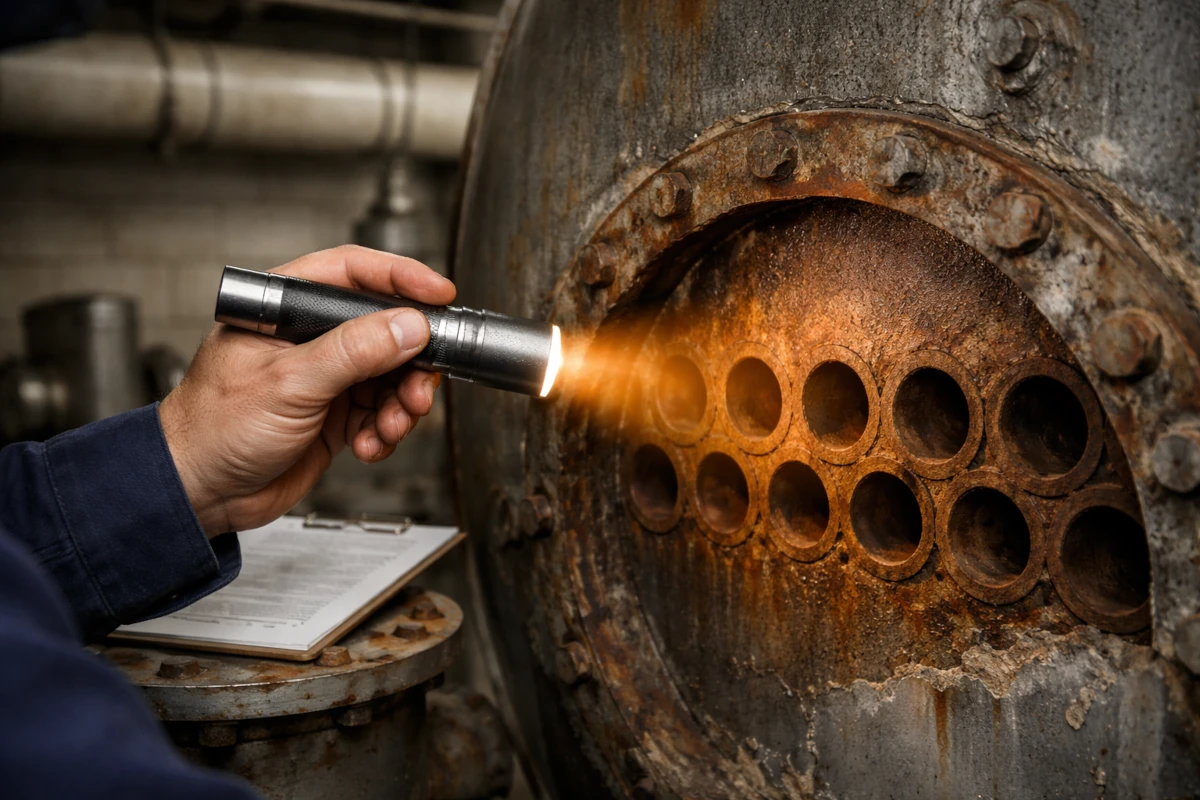
Corrosion, chronic leaks, or structural concerns. Visible corrosion on the pressure vessel, persistent tube leaks, or documented structural wear are not deferred maintenance items. They are safety concerns that compress your decision timeline.
If two or more of these are present in your facility today, this is not a “maybe next year” conversation. It’s a spring planning conversation.
Is It Repair or Replace? A Framework That Cuts Through the Noise
The repair-vs-replace question comes up in every aging boiler conversation. Here’s a grounded way to think through it:
Calculate the repair-to-replace ratio. Divide the cost of the proposed repair by the cost of replacement. Industry rule of thumb: if that ratio exceeds 50%, especially on a unit older than 15 years, replacement is usually the better long-term investment.
Assess remaining service life honestly. A 25-year-old boiler that has been well-maintained and recently retubed may have 5–8 years of reliable service remaining. A 22-year-old unit that has been chronically under-maintained may not. The physical condition of the pressure vessel, the quality of the tube sheets, and the integrity of the refractory all factor into this assessment.
Factor in efficiency economics. A modern replacement, properly sized for your load, will operate at meaningfully higher efficiency than an aging unit. In California, where natural gas costs are substantial, that efficiency delta translates directly into annual operating savings. Model it out over 5 and 10 years.
Consider your emissions exposure. If your current unit will require a permit modification or burner upgrade to remain compliant in the next 2–3 years, include that cost in the repair column.
Bay City Boiler’s boiler replacement and installation team can walk through this framework with you, including a realistic efficiency analysis for your specific equipment and facility. The goal is a clear-eyed decision, not a sales pitch.
What Does a Commercial Boiler Replacement Actually Take? A Realistic Timeline
This is where spring planning earns its value. Most facility managers, when they finally decide to replace, are surprised by how long the process takes. Here’s an honest look at the timeline:
Equipment lead times: 8–20 weeks. Standard firetube boilers from quality manufacturers are typically available in 8–12 weeks from order. Larger watertube units, custom-engineered systems, or specialty configurations can run 16–20 weeks or more. The equipment is built to order, not pulled from a warehouse.
Air district permitting: 4–16 weeks depending on jurisdiction. In California, replacement of combustion equipment typically triggers an Authority to Construct (ATC) permit application with your local air district. Bay Area facilities working under BAAQMD, Southern California facilities under SCAQMD, and Central Valley facilities under SJVAPCD each face different timelines and requirements. Complex applications or facilities with prior compliance history can extend this process. Starting in spring gives you the runway without heating season pressure compressing it.
Mechanical coordination and installation: 1–4 weeks. Depending on installation complexity, including piping modifications, structural considerations, control integration, and stack work, installation can range from a week for a straightforward swap to a month or more for a larger system reconfiguration.
Startup and commissioning: 1–2 weeks. A properly commissioned boiler is not just one that fires. It’s one whose controls, safeties, combustion parameters, and system integration have all been verified and documented. Do not shortcut this step.
Add it up conservatively: a spring decision in April can position you for a commissioned, permitted, operational replacement by late summer or early fall, before heating season begins. A fall decision in October puts you in a race you may not win.
How Does Your Facility Keep Running During the Replacement?
This is the objection that keeps facility managers from moving forward. The boiler can’t go offline for two months. There are processes, occupants, and operations that depend on it.
This is exactly what rental boilers are designed for.
Bay City Boiler maintains a rental boiler fleet specifically for bridge applications during planned replacement projects. A properly sized rental unit can maintain your process steam or heating load throughout the removal and installation window. The rental is delivered, set up, and operational before your existing equipment is taken offline, minimizing gap time and protecting your facility’s continuity.
The key word here is planned. A rental bridge during a structured spring replacement is a smooth, scheduled handoff. A rental bridge during an emergency October breakdown is a scramble: equipment availability is not guaranteed, delivery timelines compress, and your team is executing a complex operation under pressure.
Facility managers who have done both describe them as entirely different experiences.
Why Spring Is the Strategic Window
The case for spring boiler replacement planning isn’t complicated. It comes down to control.
When you plan in spring, you control the timeline. You’re not reacting to a failure — you’re executing a project. Equipment lead times are workable. Permitting queues are lighter. Your rental bridge is arranged. Your team isn’t managing an emergency alongside a replacement.
When you wait until fall, you’ve surrendered that control. Decisions that should take weeks get compressed into days. Equipment availability becomes uncertain. Permitting can’t be rushed. And the pressure of an approaching heating season shapes every decision in ways that don’t always serve the facility’s long-term interests.
Bay City Boiler’s commercial boiler services team has managed replacement projects for California facilities across every sector: food processing, healthcare, biotech, breweries, commercial properties. The ones that go smoothly share one characteristic. They were planned before the pressure started.
“The service we received was the best I’ve ever experienced with a boiler company. I couldn’t be happier. It’s comforting knowing that we have Bay City Boiler providing us with our company’s needs.” — Bay City Boiler customer
Frequently Asked Questions
How long does commercial boiler replacement take in California?
The full timeline from decision to commissioned replacement typically runs 14–26 weeks when you account for equipment lead times, air district permitting, mechanical installation, and startup. Planning in spring positions you to complete the process before fall heating season. Emergency replacements in fall compress this timeline severely and often involve compromises on equipment availability or permitting completeness.
When is the best time to replace a commercial boiler in California?
Spring, specifically April through June, is the strategic window for commercial boiler replacement planning in California. Heating season has just ended, so there’s no immediate pressure on the system. Equipment lead times are workable, air district permitting queues are lighter, and rental bridge fleet availability is strong. Waiting until fall means executing under pressure with fewer options.
What are the signs that a commercial boiler needs replacement instead of repair?
Key indicators include: age over 20 years, repair costs approaching 30–50% of replacement cost per year, documented efficiency decline, emissions compliance exposure, and structural concerns like corrosion or chronic tube leaks. If two or more of these are present, a replacement evaluation is the appropriate next step, not another repair.
How do I keep my facility running during a boiler replacement?
A rental boiler bridge is the standard solution for planned replacement projects. Bay City Boiler’s rental fleet is sized for commercial and industrial applications and can maintain your steam or heating load throughout the replacement window. The rental is set up before your existing unit is taken offline, minimizing any gap in service.
Does boiler replacement require a permit in California?
Yes. Replacing combustion equipment in California typically requires an Authority to Construct (ATC) permit from your local air district: BAAQMD in the Bay Area, SCAQMD in Southern California, or SJVAPCD in the Central Valley. Permit timelines vary by district and application complexity. Starting the permitting process in spring gives you the runway to complete it without being pressured by heating season.
What is the difference between a boiler repair and a boiler replacement from a cost perspective?
The standard rule of thumb: if the cost of a proposed repair exceeds 30–50% of the replacement cost, especially on a unit older than 15 years, replacement typically delivers better long-term value. You should also factor in ongoing efficiency costs, emissions compliance exposure, and remaining useful service life. Bay City Boiler’s team can model this out for your specific situation.
The Right Time to Plan Is Now
Spring boiler replacement planning is what proactive stewardship of your facility looks like. You have the time, the options, and the control that fall will not give you.
If your boiler is showing the signs — age, repair history, efficiency decline, emissions exposure — don’t wait for the October crisis to confirm what you already suspect. Talk to a steam systems expert about your replacement options now, while the runway exists to do this right.
Contact Bay City Boiler or call 800-8-LOW-NOX to discuss a replacement evaluation for your California facility. We’ve been doing this since 1976 and we’ve seen what planned replacements look like. There’s only one version you want.